Dear Serial Readers,
I enjoyed reading about your own reading concurrent with this Trollope serial. Just this weekend while reading the fourth installment of Small House, I also read Frederick Douglass's 1845 slave narrative, which was also published in Britain followed by his lecture tour there. I mention this because, especially during the momentous Obama Week, the extraordinariness of Douglass's narrative renders the trials and tribulations of the Dales and Crosbies and Eameses of Barsetshire and beyond very small and very ordinary, from the wealthier squire and countess to the Lupexes and Ropers. As Maura mentioned, all seems to be about money and class, or L.S.D. Yet, to paraphrase Darwin, there is grandeur in this view of life, in taking the mundane and following its incremental movements.
I'm amused that so many of you are not inclined toward Johnny Eames, despite Trollope's narratorial pitch for hobbledehoyism and the "fragment" (or incomplete, imperfect) hero. Julia's post on the gender-crossing inflections of Trollope's characters highlights an element of interest in my reading too. In this respect I found intriguing Trollope's insect imagery of grub and butterfly. Does it seem likely Crosbie and Lily will in the end marry?
This time, as the novel progresses, I begin to see more trajectories in the ever-expanding network of characters and their places (social and geographical). Triangulating the Great and Small Houses in Allington is Mrs Roper's Lodging House, in Burton Crescent London. This venue is definitely a lower rung on the social ladder, yet perhaps an interesting corollary of various intrigues around money and marriage to the Allington scene. And now we have a Courcy Castle on Crosbie's horizon (with the upper-crust sisters with their fancy names Margaretta and Alexandrina).
I'm still interested in potential widow power, too, and so far, we have at least three widows--Dale, Eames, Roper.
Some logistical matters about this blog: a few people have asked how to post. Underneath each main entry, at the bottom, is information about the date and time of the post followed by "Comments" with a number before it. If you click on "Comments" area, you'll then get a screen with a box for leaving a comment. If you don't have a Google Blogger identity already, you'll be prompted to create one. And others have asked for the reminder messages whenever I post. I'm limited to ten email addresses, but will forward on to anyone else these posts.
Next week, chapters 13-15, for January 1863.
Until then,
Serial Susan
POOR MISS FINCH by Wilkie Collins
25 January 2009


18 January 2009
The Small House at Allington--chaps 7-9 (Nov 1862)
Dear Serial Readers,
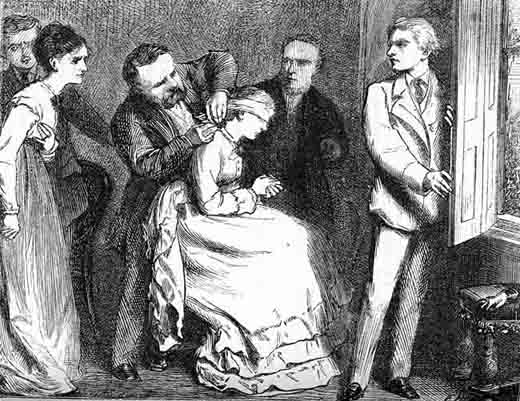
Julia's comment about the illustrations reminded me of a few I found on the internet. This one (see sidebar) comes with the caption, "The Beginning of Troubles," the title of Chapter 7. However, I thought the usual format for the installments in The Cornhill was a Millais illustration as a frontispiece at the start of the set of three chapters, but not necessarily for the chapter that opens the monthly segment. In any case, any thoughts about where this image (see sidebar) matches the narrative?
This week's portion makes me think of simultaneity--how the narrator points out the mental states of characters at the same time as their external behavior and as ongoing conditions that we readers are able to see, thanks to the narrator's reflections. But how well are characters able to comprehend the mental states of their companions? Trollope provides different instances of simultaneity here. To provide one of many examples: we learn about Crosbie's "melancholy fits" and his concern about his pinched finances given his impending marriage. Then the narrator shifts to Lily at the "Small House," with the question, "And what was the state of Lily's mind at the same moment...?" So we're primed to think of correspondences in this way too.
Then there are the narrator's interventions, his thoughts on the players and actions in the story he's unfolding. This narrator has such presence in the novel, as some of you have pointed out! He has no pity for the "Mrs Boyces," he lets us know, and he thinks there's some lurking aggression behind the polite phrase, "It is nice of you to come early," delivered by Lily to Mrs Eames before the other guests have arrived for the party. These too might be considered a kind of simultaneity, a running commentary on characters and their actions (whether internal or external) as they occur.
I was thinking of other kinds of simultaneities too even beyond the installment. In this issue (as well as the previous two) of The Cornhill, George Eliot's serial novel Romola was also appearing. How did readers juggle the simultaneity of different plot lines and casts of characters, one in a contemporary English country setting, the other in late 15th-century Florence?
What else are you reading now? What is the simultaneity of your reading practice these days?
For next week, chapters 10-12.
Simultaneously Serial,
Susan
Julia's comment about the illustrations reminded me of a few I found on the internet. This one (see sidebar) comes with the caption, "The Beginning of Troubles," the title of Chapter 7. However, I thought the usual format for the installments in The Cornhill was a Millais illustration as a frontispiece at the start of the set of three chapters, but not necessarily for the chapter that opens the monthly segment. In any case, any thoughts about where this image (see sidebar) matches the narrative?
This week's portion makes me think of simultaneity--how the narrator points out the mental states of characters at the same time as their external behavior and as ongoing conditions that we readers are able to see, thanks to the narrator's reflections. But how well are characters able to comprehend the mental states of their companions? Trollope provides different instances of simultaneity here. To provide one of many examples: we learn about Crosbie's "melancholy fits" and his concern about his pinched finances given his impending marriage. Then the narrator shifts to Lily at the "Small House," with the question, "And what was the state of Lily's mind at the same moment...?" So we're primed to think of correspondences in this way too.
Then there are the narrator's interventions, his thoughts on the players and actions in the story he's unfolding. This narrator has such presence in the novel, as some of you have pointed out! He has no pity for the "Mrs Boyces," he lets us know, and he thinks there's some lurking aggression behind the polite phrase, "It is nice of you to come early," delivered by Lily to Mrs Eames before the other guests have arrived for the party. These too might be considered a kind of simultaneity, a running commentary on characters and their actions (whether internal or external) as they occur.
I was thinking of other kinds of simultaneities too even beyond the installment. In this issue (as well as the previous two) of The Cornhill, George Eliot's serial novel Romola was also appearing. How did readers juggle the simultaneity of different plot lines and casts of characters, one in a contemporary English country setting, the other in late 15th-century Florence?
What else are you reading now? What is the simultaneity of your reading practice these days?
For next week, chapters 10-12.
Simultaneously Serial,
Susan
13 January 2009
The Small House at Allington--chaps 4-6 (Oct 1862)
Dear Serial Readers,
We're off to a roaring start with Trollope! I want to forecast some guest blogging on this novel in the next months including some Trollope scholars (of the well-published variety) and a prominent contemporary playwright who knows Victorian literature inside out! I'll try to give advance notice.
I agree with Burt that Trollope's narrator's intrusions are especially interesting--and prevalent early on in this novel. For instance, the long commentary on the "hobbledehoy." Joshua's post about Trollope's sympathetic eye toward flawed characters also seemed to anticipate this disquisition on the narrator's favorite hobbledehoy Johnny Eames in the first chapter of this second installment. It's clear that Trollope has a penchant for awkward (even borderline--with all the attendant blushing) masculinity in many of his novels, and I can appreciate Eames as part of a larger chorus of Trollopian hobbledehoys elsewhere. This hobbledehoy theory of the modern hero extends the earlier assertion about a "fraction of a hero"--a downsized masculinity from traditional (chivalric, muscular Christian?) proportions. So, is there a feminine counterpart lurking somewhere in these pages? Perhaps Lily?
And Trollope sets this darling hobbledehoy against the "mere" Appolonian Crosbie. And here's a clear difference from Austen (and perhaps a link to Eliot): the narrative steps into a marriage engagement (Lily and Crosbie) early on, but one that's set up to be, well, broken or suspended? Perhaps the Crosbie/Eames comparison also reflects what Mary mentioned about the tension between constancy and change. The comparison of these men also has class implications, like Johnny Eames's two love interests: Lily (the socially superior love he cannot declare) and Amelia Roper, the landlady's daughter (the love he declares rather precipitously, under the influence). Interesting too that these various characters are linked to either the countryside estate or the modern city.
Related to this classing of marriage plot options, one of the most humorous and telling elements of this installment for me was the use of initials--"About L.D." for chapter five and for Lily Dale did make me think of the abbreviations for pounds and pence which Trollope then makes explict in the words of Johnny on "L.S.D." Trollope isn't shy about disclosing the material interests of marriage plotting--money and social status (subject to change). And this reminds me of Maura's comment about Mrs Dale and widows who need to concern themselves with fiscal matters. Clearly Lily's engagement to the "mere clerk" pleases her relatives, especially her mother, even if we have a sense of complicated feelings from Bell on this match. Some of my all-time favorite Trollope heroines are widows (Mrs Greenow in Can You Forgive Her? and Mrs. Hurtle, the fiesty American widow in The Way We Live Now, and Madame Max Goesler) in part because they also exercise more power and knowledge than their younger pre-marital heroine counterparts. These widows are also outsiders in some sense or other (class, nation, race) to traditional elite Englishness. So I'm also hoping Mrs Dale proves THE widow of this series and that her eating alone or neglecting her peas leads to interesting developments.
Looking forward to more: #3 for next week (chaps 7-9).
Yours in installments,
Serial Susan
We're off to a roaring start with Trollope! I want to forecast some guest blogging on this novel in the next months including some Trollope scholars (of the well-published variety) and a prominent contemporary playwright who knows Victorian literature inside out! I'll try to give advance notice.
I agree with Burt that Trollope's narrator's intrusions are especially interesting--and prevalent early on in this novel. For instance, the long commentary on the "hobbledehoy." Joshua's post about Trollope's sympathetic eye toward flawed characters also seemed to anticipate this disquisition on the narrator's favorite hobbledehoy Johnny Eames in the first chapter of this second installment. It's clear that Trollope has a penchant for awkward (even borderline--with all the attendant blushing) masculinity in many of his novels, and I can appreciate Eames as part of a larger chorus of Trollopian hobbledehoys elsewhere. This hobbledehoy theory of the modern hero extends the earlier assertion about a "fraction of a hero"--a downsized masculinity from traditional (chivalric, muscular Christian?) proportions. So, is there a feminine counterpart lurking somewhere in these pages? Perhaps Lily?
And Trollope sets this darling hobbledehoy against the "mere" Appolonian Crosbie. And here's a clear difference from Austen (and perhaps a link to Eliot): the narrative steps into a marriage engagement (Lily and Crosbie) early on, but one that's set up to be, well, broken or suspended? Perhaps the Crosbie/Eames comparison also reflects what Mary mentioned about the tension between constancy and change. The comparison of these men also has class implications, like Johnny Eames's two love interests: Lily (the socially superior love he cannot declare) and Amelia Roper, the landlady's daughter (the love he declares rather precipitously, under the influence). Interesting too that these various characters are linked to either the countryside estate or the modern city.
Related to this classing of marriage plot options, one of the most humorous and telling elements of this installment for me was the use of initials--"About L.D." for chapter five and for Lily Dale did make me think of the abbreviations for pounds and pence which Trollope then makes explict in the words of Johnny on "L.S.D." Trollope isn't shy about disclosing the material interests of marriage plotting--money and social status (subject to change). And this reminds me of Maura's comment about Mrs Dale and widows who need to concern themselves with fiscal matters. Clearly Lily's engagement to the "mere clerk" pleases her relatives, especially her mother, even if we have a sense of complicated feelings from Bell on this match. Some of my all-time favorite Trollope heroines are widows (Mrs Greenow in Can You Forgive Her? and Mrs. Hurtle, the fiesty American widow in The Way We Live Now, and Madame Max Goesler) in part because they also exercise more power and knowledge than their younger pre-marital heroine counterparts. These widows are also outsiders in some sense or other (class, nation, race) to traditional elite Englishness. So I'm also hoping Mrs Dale proves THE widow of this series and that her eating alone or neglecting her peas leads to interesting developments.
Looking forward to more: #3 for next week (chaps 7-9).
Yours in installments,
Serial Susan
07 January 2009
The Small House at Allington--chaps 1-3 (Sept 1862)
Dear Serial Readers,
One of Trollope's stylistic features is his narrator's addresses to readers--there are many of them even in this first installment. Trollope uses "I" and "we" as if to suggest that the narrator and reader are partners in this telling/hearing of story. The second sentence of the novel begins "Our story...." Much of the first two chapters is exposition, backstory: who are the Dales and why a "small" house at Allington? Trollope delights as much here with establishing his characters ("our Christopher Dale") as places, particularly that titular "Small House."
By the third chapter, I have the decided impression that one character stands out among the rest--Lily Dale, with her "spice of obstinacy" as a hallmark of Trollope's most endearing heroines such as Glencora Palliser or Madame Max. And the narrator is determined that the reader should know at this early stage that "my story will be nothing to him [generic male reader] if he doe not love Lily Dale." What about women readers who love Lily? Aren't they more legion than the presumed men readers? Besides her spicy obstinacy, we learn that she is "queen of the croquet ground" and likes to use slangy vulgar language, much to her more restrained or refined sister Bell's dismay.
Does this portrait of the two Dale sisters living as poorer relations, with their mother, on the Dale estate remind anyone of a Jane Austen novel? But updated--how? Clearly two marriage plots are underway--Bell and Dr Crofts, and then Lily and, well, two possibilities--Johnny Eames and Mr. Crosbie. I couldn't help but think that Lily's complaining about this "mere clerk" may be a telltale sign that she will come to revise this estimation. That there will be more than one suitor also seems evident by the narrator's insistence on the heroes as cut into fragments, with Crosbie as one such "fraction of a hero." Or does this kind of division suggest a different kind of hero, one who is more ordinary than loomingly extraordinary?
Next time, chapters 4-6. After this week, I plan to read on Sundays and post Sundays or Mondays. Looking forward to your comments on this inaugural episode! If you just get your copy, say, next week, you can easily catch up.
Question: If this were a WOVEL (see sidebar item and NPR story), what direction would you like to see the courtship plots take?
Yours in Trollopiana,
Serial Susan
One of Trollope's stylistic features is his narrator's addresses to readers--there are many of them even in this first installment. Trollope uses "I" and "we" as if to suggest that the narrator and reader are partners in this telling/hearing of story. The second sentence of the novel begins "Our story...." Much of the first two chapters is exposition, backstory: who are the Dales and why a "small" house at Allington? Trollope delights as much here with establishing his characters ("our Christopher Dale") as places, particularly that titular "Small House."
By the third chapter, I have the decided impression that one character stands out among the rest--Lily Dale, with her "spice of obstinacy" as a hallmark of Trollope's most endearing heroines such as Glencora Palliser or Madame Max. And the narrator is determined that the reader should know at this early stage that "my story will be nothing to him [generic male reader] if he doe not love Lily Dale." What about women readers who love Lily? Aren't they more legion than the presumed men readers? Besides her spicy obstinacy, we learn that she is "queen of the croquet ground" and likes to use slangy vulgar language, much to her more restrained or refined sister Bell's dismay.
Does this portrait of the two Dale sisters living as poorer relations, with their mother, on the Dale estate remind anyone of a Jane Austen novel? But updated--how? Clearly two marriage plots are underway--Bell and Dr Crofts, and then Lily and, well, two possibilities--Johnny Eames and Mr. Crosbie. I couldn't help but think that Lily's complaining about this "mere clerk" may be a telltale sign that she will come to revise this estimation. That there will be more than one suitor also seems evident by the narrator's insistence on the heroes as cut into fragments, with Crosbie as one such "fraction of a hero." Or does this kind of division suggest a different kind of hero, one who is more ordinary than loomingly extraordinary?
Next time, chapters 4-6. After this week, I plan to read on Sundays and post Sundays or Mondays. Looking forward to your comments on this inaugural episode! If you just get your copy, say, next week, you can easily catch up.
Question: If this were a WOVEL (see sidebar item and NPR story), what direction would you like to see the courtship plots take?
Yours in Trollopiana,
Serial Susan
04 January 2009
Starting Soon: Trollope's Small House at Allington
Dear Serial Readers,
Anthony Trollope's The Small House at Allington appeared in three-chapter monthly installments in The Cornhill Magazine from September 1862 to April 1864. We'll read these serial parts weekly rather than monthly. On this schedule, we'll reach the last installment in May of this year. Reading three chapters a week might occupy you for about an hour, give or take, provided on how fast you read. But generally, Trollope is a quicker "read" than Dickens. The idea here is that this serial novel is your side-dish reading, not your main course fare, particularly if you like to immerse yourself in the world of a novel and read quickly. This serial reading is a different kind of experience. I like to reserve an evening a week for my serial portion, typically Sundays.
Besides your local library, you might secure a copy of this novel via Amazon--used copies for a dollar or so, plus shipping. As with the previous Dickens novels, I'll note which chapters for the upcoming installment: chapters one through three for this first time when you'll meet the Dale sisters, especially the very memorable (among Trollope fans) Lily. Once I post on the installment, please add your own comments. I'm also happy to have anyone else take the lead for a particular week--just contact me or post here that you'd like to write the first comment for the next three chapters.
So spread the word--forward this link! If you'd rather not have these posts forwarded to you each week, just email me. Or if you'd like an email reminder each week, let me know.
Yours until the imminent Trollope launch,
Serial Susan
Anthony Trollope's The Small House at Allington appeared in three-chapter monthly installments in The Cornhill Magazine from September 1862 to April 1864. We'll read these serial parts weekly rather than monthly. On this schedule, we'll reach the last installment in May of this year. Reading three chapters a week might occupy you for about an hour, give or take, provided on how fast you read. But generally, Trollope is a quicker "read" than Dickens. The idea here is that this serial novel is your side-dish reading, not your main course fare, particularly if you like to immerse yourself in the world of a novel and read quickly. This serial reading is a different kind of experience. I like to reserve an evening a week for my serial portion, typically Sundays.
Besides your local library, you might secure a copy of this novel via Amazon--used copies for a dollar or so, plus shipping. As with the previous Dickens novels, I'll note which chapters for the upcoming installment: chapters one through three for this first time when you'll meet the Dale sisters, especially the very memorable (among Trollope fans) Lily. Once I post on the installment, please add your own comments. I'm also happy to have anyone else take the lead for a particular week--just contact me or post here that you'd like to write the first comment for the next three chapters.
So spread the word--forward this link! If you'd rather not have these posts forwarded to you each week, just email me. Or if you'd like an email reminder each week, let me know.
Yours until the imminent Trollope launch,
Serial Susan
03 January 2009
Edwin Drood #5-6 (chaps 17-23) Aug/Sept 1870
Dear Serial Readers,
I knew when I started THE MYSTERY OF EDWIN DROOD that Dickens died before finishing it. But still I felt a bit unprepared for the rather abrupt in medias res of the last existing chapter.
In the intro to the Oxford edition, Margaret Cardwell reviews the various speculations about how Dickens intended to conclude the novel. I was surprised to learn there has been a rift between readers who believed Jasper murdered Drood, and readers who believed that Drood did succeed in his determination to wander abroad. Actually, this difference of opinion is shared by the residents of Cloisterham, as indicated early in the last chapter.
To my mind, there were so many (bordering on the overdetermined) clues that Jasper had indeed murdered Drood. First, his motivation to marry Rosa by getting rid of Drood seems so evident. Jasper's "ghastly figure" and fall in a faint to the floor in #4 when he learns from Grewgious that this motivation, and thus the murder, pointless, because Rosa and Edwin had determined not to marry. And then all the details from Durdles about the corrosive effects of the lime in the river where Jasper presumably threw his victim's body, and the gold ring that Edwin had taken from his meeting with Grewgious. One of you serial readers pointed out too that Jasper's insistence that his nephew was murdered, rather than had run away, implies his guilty knowledge. What other clues did you discover? Are you fairly certain about the "mystery" even without clear resolution?
According to John Forster, Dickens's original biographer, Dickens meant for that gold ring to be recovered as metal that would resist the effects of the lime, which would have been on Edwin's body, now destroyed by the corrosive lime. The exact details of Jasper's crime were to be presented in final chapters, claims Forster, as the murderer confesses in writing from his prison cell. Forster also believed that Rosa was to marry Tartar and that Crisparkle and Helena were to marry. No word, at least from Cardwell's intro, about plans for Neville Landless. In a 1906 magazine article, Kate Dickens claimed that her father cared less for the intricate working out of the plot details than for "his strange insight into the tragic secrets of the human heart."
My favorite part of these last chapters is the return of "the Princess Puffer," the "haggard old woman" from the East London opium den in the opening chapter. In a way, she figures as a detective who had heard something about Jasper's imagined wanderings during his opium episodes, something that seems to make her suspicious that "Ned" is a "threatened" and "dangerous" name, as she tells Drood in chap 14, just before he goes to his uncle's that fateful Christmas Eve. Why does the Princess Puffer then follow Jasper back to Cloisterham after his return trip for more opium in chap 23? And who is Dick Datchery to whom she relays some of the details of her opium business? I was also intrigued by the details of opium consumption in the novel, both in the first and last chapters. Does opium usage facilitate some insight or illumination that assists the working out of the mystery here? A few decades later, Arthur Conan Doyle certainly seemed to think that cocaine aided Sherlock Holmes in his detective work. Who knew he was indepted to the Princess Puffer!
So concludes my comments on Dickens's final, if inconclusive, serial novel. Stay tuned to our next reading adventure, Serial Readers! I'll send out a message directly on Anthony Trollope's THE SMALL HOUSE AT ALLINGTON!
Serially finished, for now,
Susan
I knew when I started THE MYSTERY OF EDWIN DROOD that Dickens died before finishing it. But still I felt a bit unprepared for the rather abrupt in medias res of the last existing chapter.
In the intro to the Oxford edition, Margaret Cardwell reviews the various speculations about how Dickens intended to conclude the novel. I was surprised to learn there has been a rift between readers who believed Jasper murdered Drood, and readers who believed that Drood did succeed in his determination to wander abroad. Actually, this difference of opinion is shared by the residents of Cloisterham, as indicated early in the last chapter.
To my mind, there were so many (bordering on the overdetermined) clues that Jasper had indeed murdered Drood. First, his motivation to marry Rosa by getting rid of Drood seems so evident. Jasper's "ghastly figure" and fall in a faint to the floor in #4 when he learns from Grewgious that this motivation, and thus the murder, pointless, because Rosa and Edwin had determined not to marry. And then all the details from Durdles about the corrosive effects of the lime in the river where Jasper presumably threw his victim's body, and the gold ring that Edwin had taken from his meeting with Grewgious. One of you serial readers pointed out too that Jasper's insistence that his nephew was murdered, rather than had run away, implies his guilty knowledge. What other clues did you discover? Are you fairly certain about the "mystery" even without clear resolution?
According to John Forster, Dickens's original biographer, Dickens meant for that gold ring to be recovered as metal that would resist the effects of the lime, which would have been on Edwin's body, now destroyed by the corrosive lime. The exact details of Jasper's crime were to be presented in final chapters, claims Forster, as the murderer confesses in writing from his prison cell. Forster also believed that Rosa was to marry Tartar and that Crisparkle and Helena were to marry. No word, at least from Cardwell's intro, about plans for Neville Landless. In a 1906 magazine article, Kate Dickens claimed that her father cared less for the intricate working out of the plot details than for "his strange insight into the tragic secrets of the human heart."
My favorite part of these last chapters is the return of "the Princess Puffer," the "haggard old woman" from the East London opium den in the opening chapter. In a way, she figures as a detective who had heard something about Jasper's imagined wanderings during his opium episodes, something that seems to make her suspicious that "Ned" is a "threatened" and "dangerous" name, as she tells Drood in chap 14, just before he goes to his uncle's that fateful Christmas Eve. Why does the Princess Puffer then follow Jasper back to Cloisterham after his return trip for more opium in chap 23? And who is Dick Datchery to whom she relays some of the details of her opium business? I was also intrigued by the details of opium consumption in the novel, both in the first and last chapters. Does opium usage facilitate some insight or illumination that assists the working out of the mystery here? A few decades later, Arthur Conan Doyle certainly seemed to think that cocaine aided Sherlock Holmes in his detective work. Who knew he was indepted to the Princess Puffer!
So concludes my comments on Dickens's final, if inconclusive, serial novel. Stay tuned to our next reading adventure, Serial Readers! I'll send out a message directly on Anthony Trollope's THE SMALL HOUSE AT ALLINGTON!
Serially finished, for now,
Susan
07 December 2008
Edwin Drood #4 (chaps 13-16) July 1870
Dear Serial Readers,
Is anyone out there in Serial Reading Land? I would love to know that you're reading along serially, either the novel or these entries, or both! For the next selection, how about branching out with a Trollope or Collins novel? Check the MOUSEHOLD WORDS catalogue which includes both Trollope's HE KNEW HE WAS RIGHT and Collins's THE EVIL GENIUS. Or Trollope's wonderful THE SMALL HOUSE AT ALLINGTON (a magazine serial) would be a nice change of pace. If you'd like to vote on one of these, or suggest another Victorian serial, please indicate your choice here or email me. We'll be ready to start the next novel in early January. And one more thing--I'd appreciate it if you'd email the link to SERIAL READERS to at least one other person, and encourage anyone to share this blog with book club readers. There was an article in the New York Times yesterday about book clubs including the online variety (Joanne Kaufman, "Fought Over Any Good Books Lately?") in which the mere suggestion of reading Trollope appears to prompt a violent reaction. I hope whoever wants to read Trollope joins THIS group!
This fourth (of six) installment of DROOD is superb! Rather than the "mystery of Edwin Drood" and his rather predictable disappearance at the hands of Jasper, we're prompted to pay close attention to the peripherals, especially the somersaulting mind and behaviors of Jasper, and the accumulation of clues, even circumstantial evidence that we know adds up to a false accusation against Neville.
Again, I marveled at all the allusions to time--the early reference to the "revolving year" (crucial to the serial form itself) as Miss Twinkleton's young ladies leave for the holiday season; the references to time of day as well as time of year in chapter 14 where Edwin's watch has stopped, the description of Edwin "surrounded by vestiges of old time and decay," the image of time torn asunder--the hands of the Cathedral clock destroyed by the night wind, and finally in chap 16 the discovery of Edwin's watch in the Weir, "run down, before being cast into the water." All these sundry references in the larger context of putting readers (both internal and external) on the watch--for the "mystery" of Edwin's disappearance, for signs of his body, for signs of Jack's guilt. The most melodramatic instance of this last item is Jasper fainting upon hearing that his motive for removing his nephew as an obstacle to his marriage plotting against Rosa no longer holds. And all this time I thought that illustration of the body on the floor *was* the Mystery of Edwin Drood!
Related to this halting of time is chapter fourteen, where Dickens employs that increasingly suspenseful present tense. I loved the staginess of this chapter which begins with sentence fragments without verbs at all, like stage directions to set the scene: "Christmas Eve in Cloisterham. A few strange faces in the streets..." Then the chapter divides into three parts, each following the key actors of the scene, all bound to converge at Jack's house for the fateful encounter, as each of these sections on, respectively, Neville, Edwin, John Jasper concludes with "And so *he* goes up the postern stair." Yet of course that pivotal scene is foreclosed from the narrative. We can only speculate and test our hunches against the narratives Neville and Jasper provide of last seeing Edwin.
The last point I want to mention is the treatment of Neville as suspect. Besides the heap of circumstantial evidence, all given with many large grains of salt, Dickens suggests the prejudice of racism--the mayor's assessment of Neville's guilt ("the case had a dark look") linked to Neville's "Un-English complexion," and then the passage about "the wildest frenzy and fatuity of evil report arose against" Neville. Here these rumors picture Neville as a ruthless imperious force who "had caused to be whipped to death sundry 'Natives.'" I found this passage especially double-edged, since on the one hand it seems to ridicule the ignorance of Cloisterham people about others across the globe, Neville included. On the other hand, Dickens seems to ridicule their ideas of "Natives" as "nomadic persons" who were "vaguely supposed in Cloisterham to be always black, always of great virtue..." Neville's "Un-English complexion" incriminates him in the eyes of these cloistered English people, yet the narrator sets the reader up as more worldly, less prejudiced, since we know--as much as we can for certain--who is responsible for Edwin's disappearance. And here I must mention the female opium eater Edwin encounters just before he goes to his uncle's house. He recognizes in her curious state the signs of opium usage he'd noted in Jack. But there is another mystery: how does this woman know that "Ned" is a "threatened name"? We know she must be the "haggard woman" of the opening of the novel in an opium den in London. But how does she make her way here with this remark about "Ned"? Although she's less a character than a suspense intensifier, I'm still intrigued by the female characters in this novel, and wish Helena had appeared in this installment!
I'm steeled for many unresolved pieces of this story, since I know Dickens had already died in July 1870 when these words were first read in the fourth number.
Serially devoted,
Susan
Is anyone out there in Serial Reading Land? I would love to know that you're reading along serially, either the novel or these entries, or both! For the next selection, how about branching out with a Trollope or Collins novel? Check the MOUSEHOLD WORDS catalogue which includes both Trollope's HE KNEW HE WAS RIGHT and Collins's THE EVIL GENIUS. Or Trollope's wonderful THE SMALL HOUSE AT ALLINGTON (a magazine serial) would be a nice change of pace. If you'd like to vote on one of these, or suggest another Victorian serial, please indicate your choice here or email me. We'll be ready to start the next novel in early January. And one more thing--I'd appreciate it if you'd email the link to SERIAL READERS to at least one other person, and encourage anyone to share this blog with book club readers. There was an article in the New York Times yesterday about book clubs including the online variety (Joanne Kaufman, "Fought Over Any Good Books Lately?") in which the mere suggestion of reading Trollope appears to prompt a violent reaction. I hope whoever wants to read Trollope joins THIS group!
This fourth (of six) installment of DROOD is superb! Rather than the "mystery of Edwin Drood" and his rather predictable disappearance at the hands of Jasper, we're prompted to pay close attention to the peripherals, especially the somersaulting mind and behaviors of Jasper, and the accumulation of clues, even circumstantial evidence that we know adds up to a false accusation against Neville.
Again, I marveled at all the allusions to time--the early reference to the "revolving year" (crucial to the serial form itself) as Miss Twinkleton's young ladies leave for the holiday season; the references to time of day as well as time of year in chapter 14 where Edwin's watch has stopped, the description of Edwin "surrounded by vestiges of old time and decay," the image of time torn asunder--the hands of the Cathedral clock destroyed by the night wind, and finally in chap 16 the discovery of Edwin's watch in the Weir, "run down, before being cast into the water." All these sundry references in the larger context of putting readers (both internal and external) on the watch--for the "mystery" of Edwin's disappearance, for signs of his body, for signs of Jack's guilt. The most melodramatic instance of this last item is Jasper fainting upon hearing that his motive for removing his nephew as an obstacle to his marriage plotting against Rosa no longer holds. And all this time I thought that illustration of the body on the floor *was* the Mystery of Edwin Drood!
Related to this halting of time is chapter fourteen, where Dickens employs that increasingly suspenseful present tense. I loved the staginess of this chapter which begins with sentence fragments without verbs at all, like stage directions to set the scene: "Christmas Eve in Cloisterham. A few strange faces in the streets..." Then the chapter divides into three parts, each following the key actors of the scene, all bound to converge at Jack's house for the fateful encounter, as each of these sections on, respectively, Neville, Edwin, John Jasper concludes with "And so *he* goes up the postern stair." Yet of course that pivotal scene is foreclosed from the narrative. We can only speculate and test our hunches against the narratives Neville and Jasper provide of last seeing Edwin.
The last point I want to mention is the treatment of Neville as suspect. Besides the heap of circumstantial evidence, all given with many large grains of salt, Dickens suggests the prejudice of racism--the mayor's assessment of Neville's guilt ("the case had a dark look") linked to Neville's "Un-English complexion," and then the passage about "the wildest frenzy and fatuity of evil report arose against" Neville. Here these rumors picture Neville as a ruthless imperious force who "had caused to be whipped to death sundry 'Natives.'" I found this passage especially double-edged, since on the one hand it seems to ridicule the ignorance of Cloisterham people about others across the globe, Neville included. On the other hand, Dickens seems to ridicule their ideas of "Natives" as "nomadic persons" who were "vaguely supposed in Cloisterham to be always black, always of great virtue..." Neville's "Un-English complexion" incriminates him in the eyes of these cloistered English people, yet the narrator sets the reader up as more worldly, less prejudiced, since we know--as much as we can for certain--who is responsible for Edwin's disappearance. And here I must mention the female opium eater Edwin encounters just before he goes to his uncle's house. He recognizes in her curious state the signs of opium usage he'd noted in Jack. But there is another mystery: how does this woman know that "Ned" is a "threatened name"? We know she must be the "haggard woman" of the opening of the novel in an opium den in London. But how does she make her way here with this remark about "Ned"? Although she's less a character than a suspense intensifier, I'm still intrigued by the female characters in this novel, and wish Helena had appeared in this installment!
I'm steeled for many unresolved pieces of this story, since I know Dickens had already died in July 1870 when these words were first read in the fourth number.
Serially devoted,
Susan
Subscribe to:
Posts (Atom)