Dear Serial Readers,
If you like fast pacing and lots of dialogue and external action, then this serial is probably a challenge for you. I'm enjoying Hardy's luxuriously slow unfolding of the world of Egdon Heath, and the meditations on and about characters across this desolate landscape. As promised at the end of #4, this installment opens with the meeting of Clym and Eustacia, whose mummer disguise as the Turkish Knight doesn't fool him. I suppose the psychic chemistry of Eustacia (with her intense and imaginative passions--after all, she's "had undoubtedly begun to love him" already) and Clym (with his "wearing habit of meditation" and "inner strenuous") promises some fireworks later on, but not yet. I'm also struck by how Hardy uses the word "depression" to describe both Clym and Eustacia. It's interesting that the heath seems to give Eusatica more freedom to roam, as her grandfather tells her she "may walk on the heath night or day as you choose," but at the same time much isolation and time for meditation.
Not much excitement in the Wildeve and Thomasin match, after Eustacia clarifies that she's no longer interested in him. What does interest me? Reddleman Diggory Venn. The chapter titled "A Coalition Between Beauty and Oddness" must surely refer to him! His disinterested love for Thomasin, his kindness, his social status as quite malleable (he's educated, he could be a dairyman), his sensitivity to others are all part of his "beauty" along with his "obscure rubicundity of person"--love that word, "rubicundity"! What does this redness mean--how to read it?
Is it unusual for an unmarried woman to "give" the bride away, as Eustacia does Thomasin?
Next up is Book Third, "The Fascination"--surely more on Clym and Eustacia: chaps. 1-4.
Serially yours,
Susan
POOR MISS FINCH by Wilkie Collins
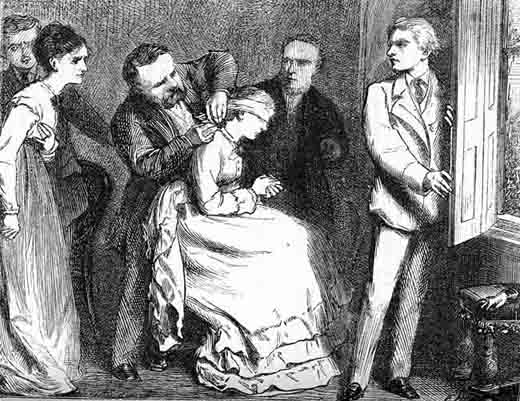
01 August 2013


24 July 2013
The Return of the Native #4 (Book II, chaps. 1-5, Belgravia April 1878)
Dear Serial Readers,
"The Arrival"--the title of this second "book" section of the novel--is a lot of fanfare for Clym's return from Paris. Like much else in the novel so far, there's some slow building up to his appearance on the scene (as "the owner of the awakening voice"), which is filtered through Eusatcia's eager eyes and ears (yes, eavesdropping, as Maura mentioned last time). Her situational boredom and depression for which infatuation seems the only available cure is primed for Clym's arrival. I do see shades of Emma Bovary here, with her great desire for "a sufficient hero," this one straight from Paris. Her plot to play the Turkish Knight in the mummers' traveling Christmas show is a bit of amusing cross-dressing. The segment ends with her searching for her love object's "form"--will he notice her? Do we care?
Like Maura mentioned with the last segment, there doesn't seem much "love" in any abiding sense (between and among Thomasin, Wildeve, Eusatacia, and who knows yet about Clym Y.), with the exception of Diggory Venn, our local Reddleman. Why does he get such top billing in the decent humanity chart? Why, as Maura asked too, are we reminded that he was once a farmer, and not always a reddleman, and that his class position was once better?
I don't know, but I see Hardy trying to reconcile clashes or what seem disparate intersections through the chance encounters and remarkable scenery of Egdon Heath. Mostly I see Hardy trying to undo the puzzle of past and present, of the past's status in the present. My favorite sentence in this episode comes at the end of the paragraph that begins with Eustacia's contempt for mummers and mumming: "This unweeting manner of performance is the true ring by which, in this refurbishing age, a fossilized survival may be known from a spurious reproduction." Hardy's narrator, unlike Eustacia Vye, seems to value customs of the past as "a fossilized survival" over an imitation or "spurious reproduction." Maybe that's why he's not writing a historical novel here set in the distant past, but trying instead to capture that past through place, through the full landscape of Egdon Heath which includes the bonfires and the mummers with their "unweeting manner of performance." "Unweeting" is apparently an archaic word for "unwitting"--funny that Hardy's language has scattered fossils of past words too.
As a stalwart serial reader, I have been paying attention to how each installment concludes with some suspenseful edge--this one with Eustacia as Turkish Knight scanning the audience for Clym's form. However, each chapter seems to end with a suspenseful note, as if to prod readers to turn the page, to continue on. I'm wondering if the cliff edge of suspense at the end of a monthly installment is much higher than those that conclude chapters.
For next time: the rest of Book II, chaps. 6-8 (end of "The Arrival").
Serially suspended,
Susan
14 July 2013
The Return of the Native #3 (Book 1, chaps. 8-11, Belgravia March 1878)
Dear Serial Readers,
I was startled to find the word "Wisconsin" in this installment! How surprising that Damon Wildeve proposes that he and Eustacia elope there where he has "kindred" (toward the end of chap. 9). The installment increases the choices for Eustacia's relocations away from the heath she hates (or loves to hate, and possibly can't quite give up altogether--): Wisconsin, Budmouth. The place of coming attraction is in the installment's last line--Paris, "that rookery of pomp and vanity." Or at least, the coming attraction of the next character Clym Yeobright is returning from Paris.
I love how Hardy juxtaposes places and times, along with the love interests, and how the appeal of these places and people is contingent on how other people desire them. Like you Serial Readers, I also have wondered about the significance of all the classical references. I read these (and more appear in this installment--Candaules, Dido and Carthage) as part of Hardy's conception of time (and place) where the ancient past lurks behind the present scenery, especially Egdon Heath with its vestiges of other times. Hardy does something similar with references to nature and space--like the birds in early chap. 10, the courser as an "African truant" and the wild mallard who "brought with him an amplitude of northern knowledge. Glacial catastrophes, snowstorm episodes, glittery auroral effects, Polaris in the zenith, Franklin underfoot"--there's a lot of allusion packed in here!
What do you make of the reddleman and his reddle? When Venn objects that Mrs. Yeobright might dislike his redness, he claims his color isn't by birth. By claiming his redness isn't a matter of race, but transient occupation, of course he's trying to win some approval from Mrs. Y in his suit for Thomasin, but is there a larger issue about race, class, and social standing here?
In all the possibilities of marriage plots, what lies ahead? If Eustacia's passion for Damon Wildeve seems dampened by the possibility that Thomasina might be willing to accept someone else instead of him, will she now turn her (bon)fire to Clym, who awaits in the wings of the next installment? Or will she have two men to choose between?
Next time, we go to the second book, "The Arrival," chapters 1-5. I really do intend to pick up the serial reading pace, readers, so stay tuned later this coming week!
Serially suspicious,
Susan
26 June 2013
The Return of the Native #2 (book 1, chaps. 5-7, Belgravia Feb. 1878)
Dear Serial Readers,
It occurred to me that original readers might have needed to review an installment given the one month break in publishing this novel. I reread this installment and enjoyed it so much more the second time around! I love the gradual revelation of the monumental Eustacia Vye who communicates with her lapsed lover Damon Wildeve by bonfire and carries around a telescope and an hour glass (because she takes "a peculiar pleasure" in seeing time "glide away"). Hardy describes within Eustacia's brain "were juxtaposed the strangest assortment of ideas, from old and from new"--and he also compares her to various figures from the past, Marie Antoinette and Mrs. Siddons (which Hardy changed in a later edition of this novel to Sappho), the Witch of Endor, and the Sphinx.
Since the novel opens on Guy Fawkes' Night (with bonfire celebrations), I suppose we should expect the volatile treason of Damon throwing off Thomasin for Eustacia in the next installments. But are we to see Eustacia as a revolutionary female Guy Fawkes? I don't, and Hardy says as much-- how this environment "made a rebellious woman saturnine." Still, I'm intrigued with her a heterogeneous character of diverse parts (like a serial, almost).
The way this installment ends makes me understand how some readers have linked Flaubert's Emma Bovary with Eustacia as a depressive type, languishing from boredom and half-baked romantic fantasies. Like Emma, she's reduced to the meager materials in her world for giving life to those dreams--or "idealising Wildeve for want of a better object."
I promise to pick up the pace of our serial reading--next time the last four chapters (chaps. 8-11) of
this first book "The Three Women" (presumably Thomasina, her aunt Mrs. Yeobright, and Eustacia).
I'll post within a week!
Serially yours,
Susan
13 June 2013
Return of the Native #1 (book 1, chaps 1-4, Belgravia Jan. 1878)
Dear Serial Readers,
The last post shows all the serial installment divisions and reading schedule--but that schedule is clearly changing! I'll post at the end the estimated date for the next session on the next installment--and we'll try to finish up this novel in month's time!
The opening portion is rather lethargic--that pastoral air in decline! So much description of place rather than person is sometimes hard to engage with. What do you notice about Hardy's Wessex?
Notice that place comes first and then the second chapter title announces: "Humanity Appears Upon the Scene, Hand in Hand with Trouble." Sort of like a reworked Genesis story of creation with heaven and heath first and then "Humanity" with the "Trouble" that gives a hint of suspense.
Who is this "Humanity"? First we have Diggory Venn, the reddleman with his "lurid red" van. The reddleman sells reddle, or red ochre dye, to farmers who mark their rams in a way that it transfers to the ewes to show that there's been some conjugal action to lead to lambs. Then various other local folks speak in dialect and we learn about Thomasin Yeobright (great name!) and Damon Wildeve (another great name!) who have gone off to marry--but apparently that didn't work out so well, since Thomasin is actually sleeping in Diggory's red van--are we supposed to think she's marked by the ram, symbolically speaking, and in the lambing way? Hmmm. The installment concludes with Mrs. Yeobright scolding her niece, "'Now Thomasin,' she said sternly, 'what's the meaning of this disgraceful performance?'" Is this enough of a cliffhanger for you to return for the next installment?
One last observation--the bonfires in across the heath seem a form of communication, and one bonfire in particular is associated with the granddaughter of Capt. Drew (whoever he is)--and she's marked (not exactly with reddle) as "very strange in her ways, living up there by herself, and such things please her." This strange woman is surely one of "The Three Women"--the title of this first Book (not installment). Does the original portion in Belgravia include this Book First title? And who is the third woman, Mrs Yeobright, Tamsin's aunt? We also learn that she has a beloved son Clym who's due home. There's a tension between the Wessex country heath (and the old folk ways of the reddleman and other inhabitants) and town life. What's that about?
Serial Readers, what are you noticing? I'd love to know more about what else appeared in that issue of the magazine Belgravia. Although this beginning seems ploddingly slow, acts of creation can move along in surprising ways!
I'll plan to post on installment two (Book First, chaps. 5-7) by early next week (June 17th).
Serially starting again,
Susan
11 June 2013
THE RETURN OF THE NATIVE reading schedule
Dear Serial Readers,
After a long interval, we are embarking on a new serial reading adventure--Thomas Hardy's The Return of the Native! This novel was serialized in the magazine Belgravia in 12 monthly parts from January to December 1878. We'll read and converse on this novel much more quickly than original readers: two installments (separately) this week, and then three installments over the next month with the plan to finish up July 8th. Thanks to Brontë Mansfield for this reading schedule which I am posting here. The very first post on the very first serial installment follows later today or tomorrow: stay tuned!
For the week of 9-16 June 2013:
Installment 1 (book 1, chaps. 1-4) for June 11th
Installment 2 (book 1, chaps. 5-7) for June 13th
For the week of 17-23 June 2013:
Installment 3 (book 1, chaps. 8-11) for June 17th
Installment 4 (book 2, chap. 1-5) for June 19th
Installment 5 (book 2, chaps. 6-8) for June 21st
For the week of 24-30 June 2013:
Installment 6 (book 3, chaps. 1-4) for June 24th
Installment 7 (book 3, chaps. 5-8) for June 26th
Installment 8 (book 4, chaps. 1-4) for June 28th
For the week of 1-8 July (final week!)
Installment 9 (book 4, chaps. 5-8) for July 1st
Installment 10 (book 5, chaps. 1-4) for July 3rd
Installment 11 (book 5, chaps. 5-8) for July 5th
Installment 12 (book 5, chap. 9 and book 6, chaps. 1-4) for July 8th
10 May 2012
Curiosity Returning
Dear Serial Readers,
I'm ready to try again, and will read the next two installments (chaps 13/14
and chaps 15/16) over the next week, and post! So since Kari seems curious,
and I'm curiouser, I'll hope more people join in. If you've not started
this serial novel, there's not that much catching up.
Serially starting (over),
Susan
Subscribe to:
Posts (Atom)