Dear Serial Readers,
Please join in reading Wilkie Collins's Poor Miss Finch, first serialized in Cassell's Magazine in 26 parts (from Sept. 1871 to Feb. 1872). To speed up our serial reading schedule, we'll aim for three installments per week, beginning the week of April 21, 2014.
The first three installments include the first 10 chapters (with the serial divisions after chapters 4, 7, 10). You might use the Oxford World's Classics edition of the novel, or you may read it online by downloading Poor Miss Finch
Rachel Herzl-Betz will join me in this serial reading adventure by sharing the lead posts. We'll alternate in some fashion, so stay tuned! Please share this website link!
Serially starting soon,
Serial Susan
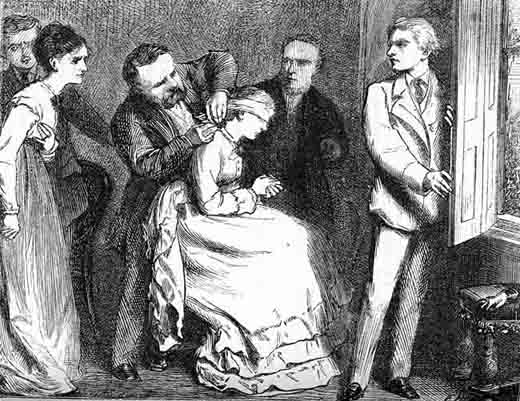
POOR MISS FINCH by Wilkie Collins
05 April 2014


26 October 2013
THE RETURN OF THE NATIVE, #11, Book Fifth, chaps. 5-8 (Belgravia 1878)
Dear Serial Readers,
Many repetitions and building suspense in this penultimate installment. First, the date--fifth of November and bonfire night--echoes the opening installment of then novel and also echoes the month of this installment. Then the repetition of the communications by signals, the fateful knocking at the door, the female figures on the stormy heath at night--how Thomasin (with baby no less) and Eustacia follow or haunt each other, as Diggory Venn confuses one for the other. This installment also seems more accented with suspense that gets replicated in several ways--the weather, the crossed signals, the mistaken reading of Wildeve's assistance to Eustacia's escape as indication of planned adultery, and then the cliffhanger ending where Thomasin "could say no more." Things don't look promising for Eustacia's survival. The question remains about her method: the pistols (if not secured well), or some other way.
One of the most interesting bits to me was Susan Nonsuch's wax effigy of Eustacia, with all those pins and then the destruction of the Eustacia effigy through flames--like the burning of witches. Of this superstition, the narrator remarks: "It was a practice well-known on Egdon at that date, and one that is not quite extinct at the present day." This captures Hardy's sense of historical process--as a palimpsest or layering, or echoing or haunting so that the past, with its anachronistic practices, is still evident in the present. Egdon Heath is part-fossilized history and ongoing present, like the evolutionary process of steady-state and slow transformations. And yet, and yet--the drama of human actors on this scene! Is Eustacia's tragic end overdetermined like the long arc of deep time?
Only the time of the last installment will tell!
Serially suspended,
Susan
Many repetitions and building suspense in this penultimate installment. First, the date--fifth of November and bonfire night--echoes the opening installment of then novel and also echoes the month of this installment. Then the repetition of the communications by signals, the fateful knocking at the door, the female figures on the stormy heath at night--how Thomasin (with baby no less) and Eustacia follow or haunt each other, as Diggory Venn confuses one for the other. This installment also seems more accented with suspense that gets replicated in several ways--the weather, the crossed signals, the mistaken reading of Wildeve's assistance to Eustacia's escape as indication of planned adultery, and then the cliffhanger ending where Thomasin "could say no more." Things don't look promising for Eustacia's survival. The question remains about her method: the pistols (if not secured well), or some other way.
One of the most interesting bits to me was Susan Nonsuch's wax effigy of Eustacia, with all those pins and then the destruction of the Eustacia effigy through flames--like the burning of witches. Of this superstition, the narrator remarks: "It was a practice well-known on Egdon at that date, and one that is not quite extinct at the present day." This captures Hardy's sense of historical process--as a palimpsest or layering, or echoing or haunting so that the past, with its anachronistic practices, is still evident in the present. Egdon Heath is part-fossilized history and ongoing present, like the evolutionary process of steady-state and slow transformations. And yet, and yet--the drama of human actors on this scene! Is Eustacia's tragic end overdetermined like the long arc of deep time?
Only the time of the last installment will tell!
Serially suspended,
Susan
24 October 2013
THE RETURN OF THE NATIVE #10 Book Fifth, chaps. 1-4 (Belgravia, Oct. 1878)
Dear Serial Readers,
I'm going to leave comments on this particular installment to others, and instead answer the question: why read this 1878 initial serial publication of this novel?
Thanks to the Oxford UP edition, based on the 1878 edition, I can offer some observations. Hardy revised his novels, this one in particular, for the 1895 edition and again for the 1912 edition. The later versions bear the marks of his more developed sense of Wessex and the parallels between his fictional names and actual places in Dorset and surroundings. Egdon Heath of the original serial version is much more indistinct and imprecise as a setting; even the map of Wessex Hardy used in the later editions differ from the 1878 edition, although I'm not sure if the map appeared in Belgravia with the installments. Also, while the divisions into six books appears in the magazine version of the novel, there are no book titles like "The Three Women" or "The Fascination" or "The Discovery." Instead there are abstracts of a few sentences as headnotes and previews for the installment. You can find these in Simon Gatrell's "Significant Revisions in the Text" section at the back of the Oxford edition.
It might be interesting to consider how the abstracts, along with the illustrations that appeared in the original magazine version, work to frame and guide reading the novel through these punctuated parts separated by a month. Beyond this, though, I think the earlier haziness of the heath in this 1878 version captures what I'd call Hardy's sense of a serial past and present--how Egdon Heath bears traces of a recorded, historical past (through proper names of people and events), but also to a past that's more inchoate, perhaps like the deep history of the geological record and evolutionary theory.
I'll be posting on the remaining three segments very soon! Any thoughts about what happens in this installment?
Serially situated,
Susan
I'm going to leave comments on this particular installment to others, and instead answer the question: why read this 1878 initial serial publication of this novel?
Thanks to the Oxford UP edition, based on the 1878 edition, I can offer some observations. Hardy revised his novels, this one in particular, for the 1895 edition and again for the 1912 edition. The later versions bear the marks of his more developed sense of Wessex and the parallels between his fictional names and actual places in Dorset and surroundings. Egdon Heath of the original serial version is much more indistinct and imprecise as a setting; even the map of Wessex Hardy used in the later editions differ from the 1878 edition, although I'm not sure if the map appeared in Belgravia with the installments. Also, while the divisions into six books appears in the magazine version of the novel, there are no book titles like "The Three Women" or "The Fascination" or "The Discovery." Instead there are abstracts of a few sentences as headnotes and previews for the installment. You can find these in Simon Gatrell's "Significant Revisions in the Text" section at the back of the Oxford edition.
It might be interesting to consider how the abstracts, along with the illustrations that appeared in the original magazine version, work to frame and guide reading the novel through these punctuated parts separated by a month. Beyond this, though, I think the earlier haziness of the heath in this 1878 version captures what I'd call Hardy's sense of a serial past and present--how Egdon Heath bears traces of a recorded, historical past (through proper names of people and events), but also to a past that's more inchoate, perhaps like the deep history of the geological record and evolutionary theory.
I'll be posting on the remaining three segments very soon! Any thoughts about what happens in this installment?
Serially situated,
Susan
03 October 2013
The Return of the Native #8 Book Fourth, chaps. 1-4 (Belgravia Aug. 1874)
Dear Serial Readers,
Given many of your comments about Hardy's poetic style, his hovering over the landscape and the slow drive of plot, I found myself thinking about the alterations between description and dialogue, between the immersion in local scenery and the frenzy of the accelerating collisions between mother and son, mother and daughter-in-law, aunt and niece and nephew-in-law, and most of all the brewing adultery plot between Eustacia and Wildeve. I find both Mrs. Yeobright and Eustacia similar in their sense of feeling enclosed: one resigned to her limited life, but hoping to escape vicariously through her son's adventures in Paris, the other also dreaming of the Parisian geographical fix. But the men seem much more wedded to Egdon, and Clym adjusts downward his aspirations as a schoolteacher into the furze-cutter, much to the dread of his young wife who wishes to escape her constricting life.
Most part of the landscape seems the reddleman, Diggory Venn, who seems almost like the furze itself (fustian furze maybe), always hovering and seeing all--a kind of analogue for the narrator. Is this reddleman a troublemaker or a peacemaker, a protective spirit especially for his beloved Thomasin?
As the adultery plot heats up by the end of this installment, I'm thinking too of Madame Bovary although there are marked differences between Emma and Eustacia. Still, for both, romantic fantasies seem the only escape possible.
How will the landscape, Hardy's poetry of place, work with or against all the human strife and drama and especially the unraveling marriage plots? Tune in.
Serially yours,
Susan
Given many of your comments about Hardy's poetic style, his hovering over the landscape and the slow drive of plot, I found myself thinking about the alterations between description and dialogue, between the immersion in local scenery and the frenzy of the accelerating collisions between mother and son, mother and daughter-in-law, aunt and niece and nephew-in-law, and most of all the brewing adultery plot between Eustacia and Wildeve. I find both Mrs. Yeobright and Eustacia similar in their sense of feeling enclosed: one resigned to her limited life, but hoping to escape vicariously through her son's adventures in Paris, the other also dreaming of the Parisian geographical fix. But the men seem much more wedded to Egdon, and Clym adjusts downward his aspirations as a schoolteacher into the furze-cutter, much to the dread of his young wife who wishes to escape her constricting life.
Most part of the landscape seems the reddleman, Diggory Venn, who seems almost like the furze itself (fustian furze maybe), always hovering and seeing all--a kind of analogue for the narrator. Is this reddleman a troublemaker or a peacemaker, a protective spirit especially for his beloved Thomasin?
As the adultery plot heats up by the end of this installment, I'm thinking too of Madame Bovary although there are marked differences between Emma and Eustacia. Still, for both, romantic fantasies seem the only escape possible.
How will the landscape, Hardy's poetry of place, work with or against all the human strife and drama and especially the unraveling marriage plots? Tune in.
Serially yours,
Susan
29 September 2013
The Return of the Native #7 (Book Third, The Fascination, chaps. 5-8)
Dear Serial Readers,
I returned to the very opening of this serial, where there is a long unwinding of the scene of Egdon Heath even before characters and dialogue appear--calm, poetic description. In this installment, in the thick of storylines, the balance shifts--dialogue and building suspense between the triangulated desires of mother, son, and his lover. The conflict between Mrs. Y and her son over what he will do with his life, and his choice of wife, is sharp and paired with Eustacia's demands on him--and the rush to marry. Interspersed are the scenes of landscape, Egdon almost the silent character, the presence that is something like a witness of human dramas. And I love how Hardy makes this environment out of deep evolutionary time--"The scene seemed to belong to the ancient world of the carboniferous period."
A corollary to this uniform, abiding presence of the landscape with its deep past is one character--the Reddleman, who seems Thomasin's guardian angel despite her declining his proposal (and now she's married to Wildeve). The movement of those 100 guineas from Mrs. Y to Christian (who is instructed to give half to Clym and half to Thomasin) to Wildeve to Venn who then gives them all to Thomasin--the "red automaton" is an interesting fixture whose home is constant movement through the landscape. At the close of "The Fascination" are two young married couples, but neither seems to have a rosy future, although Thomasin has those guineas.
Serially yours, Susan
I returned to the very opening of this serial, where there is a long unwinding of the scene of Egdon Heath even before characters and dialogue appear--calm, poetic description. In this installment, in the thick of storylines, the balance shifts--dialogue and building suspense between the triangulated desires of mother, son, and his lover. The conflict between Mrs. Y and her son over what he will do with his life, and his choice of wife, is sharp and paired with Eustacia's demands on him--and the rush to marry. Interspersed are the scenes of landscape, Egdon almost the silent character, the presence that is something like a witness of human dramas. And I love how Hardy makes this environment out of deep evolutionary time--"The scene seemed to belong to the ancient world of the carboniferous period."
A corollary to this uniform, abiding presence of the landscape with its deep past is one character--the Reddleman, who seems Thomasin's guardian angel despite her declining his proposal (and now she's married to Wildeve). The movement of those 100 guineas from Mrs. Y to Christian (who is instructed to give half to Clym and half to Thomasin) to Wildeve to Venn who then gives them all to Thomasin--the "red automaton" is an interesting fixture whose home is constant movement through the landscape. At the close of "The Fascination" are two young married couples, but neither seems to have a rosy future, although Thomasin has those guineas.
Serially yours, Susan
14 August 2013
The Return of the Native #6 (Book Third, The Fascination, chaps. 1-4, June 1878)
Dear Serial Reader(s),
Finally the word I've been thinking as the KEY to this novel has appeared early in this installment: anachronism! Yet it's about Clym's beauty and men's physicical beauty as such, whereas women's beauty "may not be an anachronism." Does Hardy have in mind classical sculpture? In any case, the novel continues to flood the descriptive passages with so many allusions to the past--the near, far, and even prehistoric pasts in this setting of "the rural world" which is not ready for "forwardness." How about Susan Nonesuch's needle attack on Eustacia in church? So much for churchgoers! Good reason to stay clear! This episode is also an amusing example of the superstitious view of Eustacia as a kind of witch (variation of contemporary view of her as what...a femme fatale?). An even more interesting anachronism is the narrator calling words (to capture love and passion) as "the rusty implements of a bygone, barbarous epoch."
Such an unusual proposal scene set during a lunar eclipse--E's melancholy thoughts on love as fickle, not eternal--and then she asks Clym to talk about Paris--Geographical cure! Historical romance! The muted Emma Bovary allusion too-- French and English views on suicide: "In France it is not uncustomary to commit suicide at this stage: in England we do much better or much worse as the case may be." What does *that* mean? The "stage" here is about youthful disillusionment--when "in a young man's life... the grimness of the general human situation first becomes clear." Yet Eustacia seems to have a more abiding sense of this grimness. I'd say the French conclusion would be her suicide, while the English would be Clym's. Let's see what happens....
One thread of this set of chapters that seemed so "modern" is the mother/son relationship--how Mrs. Y has high hopes for Clym to escape the limits of the "rural" life and have a career in Paris, and Clym's interest in returning to his heath homeland with his quasi-socialist ambitions to equalize classes by becoming a schoolteacher (which he then modifies to ditch the poor for the wealthier), and then of course his mother's suspicions and jealousy of Eustacia as having bewitched her son. Mrs. Y, despite her superior class position, is not so far removed from Susan Nonesuch in how they see Eustacia. Clym sees too the irony that despite the tension between his mother and lover, they both want the same--for Clym to return to Paris.
Next time: chaps. 5-8 in "The Fascination" section.
Serially yours,
Susan
Finally the word I've been thinking as the KEY to this novel has appeared early in this installment: anachronism! Yet it's about Clym's beauty and men's physicical beauty as such, whereas women's beauty "may not be an anachronism." Does Hardy have in mind classical sculpture? In any case, the novel continues to flood the descriptive passages with so many allusions to the past--the near, far, and even prehistoric pasts in this setting of "the rural world" which is not ready for "forwardness." How about Susan Nonesuch's needle attack on Eustacia in church? So much for churchgoers! Good reason to stay clear! This episode is also an amusing example of the superstitious view of Eustacia as a kind of witch (variation of contemporary view of her as what...a femme fatale?). An even more interesting anachronism is the narrator calling words (to capture love and passion) as "the rusty implements of a bygone, barbarous epoch."
Such an unusual proposal scene set during a lunar eclipse--E's melancholy thoughts on love as fickle, not eternal--and then she asks Clym to talk about Paris--Geographical cure! Historical romance! The muted Emma Bovary allusion too-- French and English views on suicide: "In France it is not uncustomary to commit suicide at this stage: in England we do much better or much worse as the case may be." What does *that* mean? The "stage" here is about youthful disillusionment--when "in a young man's life... the grimness of the general human situation first becomes clear." Yet Eustacia seems to have a more abiding sense of this grimness. I'd say the French conclusion would be her suicide, while the English would be Clym's. Let's see what happens....
One thread of this set of chapters that seemed so "modern" is the mother/son relationship--how Mrs. Y has high hopes for Clym to escape the limits of the "rural" life and have a career in Paris, and Clym's interest in returning to his heath homeland with his quasi-socialist ambitions to equalize classes by becoming a schoolteacher (which he then modifies to ditch the poor for the wealthier), and then of course his mother's suspicions and jealousy of Eustacia as having bewitched her son. Mrs. Y, despite her superior class position, is not so far removed from Susan Nonesuch in how they see Eustacia. Clym sees too the irony that despite the tension between his mother and lover, they both want the same--for Clym to return to Paris.
Next time: chaps. 5-8 in "The Fascination" section.
Serially yours,
Susan
01 August 2013
The Return of the Native #5 (Book Second The Arrival, chaps 6-8, Belgravia May 1878)
Dear Serial Readers,
If you like fast pacing and lots of dialogue and external action, then this serial is probably a challenge for you. I'm enjoying Hardy's luxuriously slow unfolding of the world of Egdon Heath, and the meditations on and about characters across this desolate landscape. As promised at the end of #4, this installment opens with the meeting of Clym and Eustacia, whose mummer disguise as the Turkish Knight doesn't fool him. I suppose the psychic chemistry of Eustacia (with her intense and imaginative passions--after all, she's "had undoubtedly begun to love him" already) and Clym (with his "wearing habit of meditation" and "inner strenuous") promises some fireworks later on, but not yet. I'm also struck by how Hardy uses the word "depression" to describe both Clym and Eustacia. It's interesting that the heath seems to give Eusatica more freedom to roam, as her grandfather tells her she "may walk on the heath night or day as you choose," but at the same time much isolation and time for meditation.
Not much excitement in the Wildeve and Thomasin match, after Eustacia clarifies that she's no longer interested in him. What does interest me? Reddleman Diggory Venn. The chapter titled "A Coalition Between Beauty and Oddness" must surely refer to him! His disinterested love for Thomasin, his kindness, his social status as quite malleable (he's educated, he could be a dairyman), his sensitivity to others are all part of his "beauty" along with his "obscure rubicundity of person"--love that word, "rubicundity"! What does this redness mean--how to read it?
Is it unusual for an unmarried woman to "give" the bride away, as Eustacia does Thomasin?
Next up is Book Third, "The Fascination"--surely more on Clym and Eustacia: chaps. 1-4.
Serially yours,
Susan
If you like fast pacing and lots of dialogue and external action, then this serial is probably a challenge for you. I'm enjoying Hardy's luxuriously slow unfolding of the world of Egdon Heath, and the meditations on and about characters across this desolate landscape. As promised at the end of #4, this installment opens with the meeting of Clym and Eustacia, whose mummer disguise as the Turkish Knight doesn't fool him. I suppose the psychic chemistry of Eustacia (with her intense and imaginative passions--after all, she's "had undoubtedly begun to love him" already) and Clym (with his "wearing habit of meditation" and "inner strenuous") promises some fireworks later on, but not yet. I'm also struck by how Hardy uses the word "depression" to describe both Clym and Eustacia. It's interesting that the heath seems to give Eusatica more freedom to roam, as her grandfather tells her she "may walk on the heath night or day as you choose," but at the same time much isolation and time for meditation.
Not much excitement in the Wildeve and Thomasin match, after Eustacia clarifies that she's no longer interested in him. What does interest me? Reddleman Diggory Venn. The chapter titled "A Coalition Between Beauty and Oddness" must surely refer to him! His disinterested love for Thomasin, his kindness, his social status as quite malleable (he's educated, he could be a dairyman), his sensitivity to others are all part of his "beauty" along with his "obscure rubicundity of person"--love that word, "rubicundity"! What does this redness mean--how to read it?
Is it unusual for an unmarried woman to "give" the bride away, as Eustacia does Thomasin?
Next up is Book Third, "The Fascination"--surely more on Clym and Eustacia: chaps. 1-4.
Serially yours,
Susan
Subscribe to:
Posts (Atom)